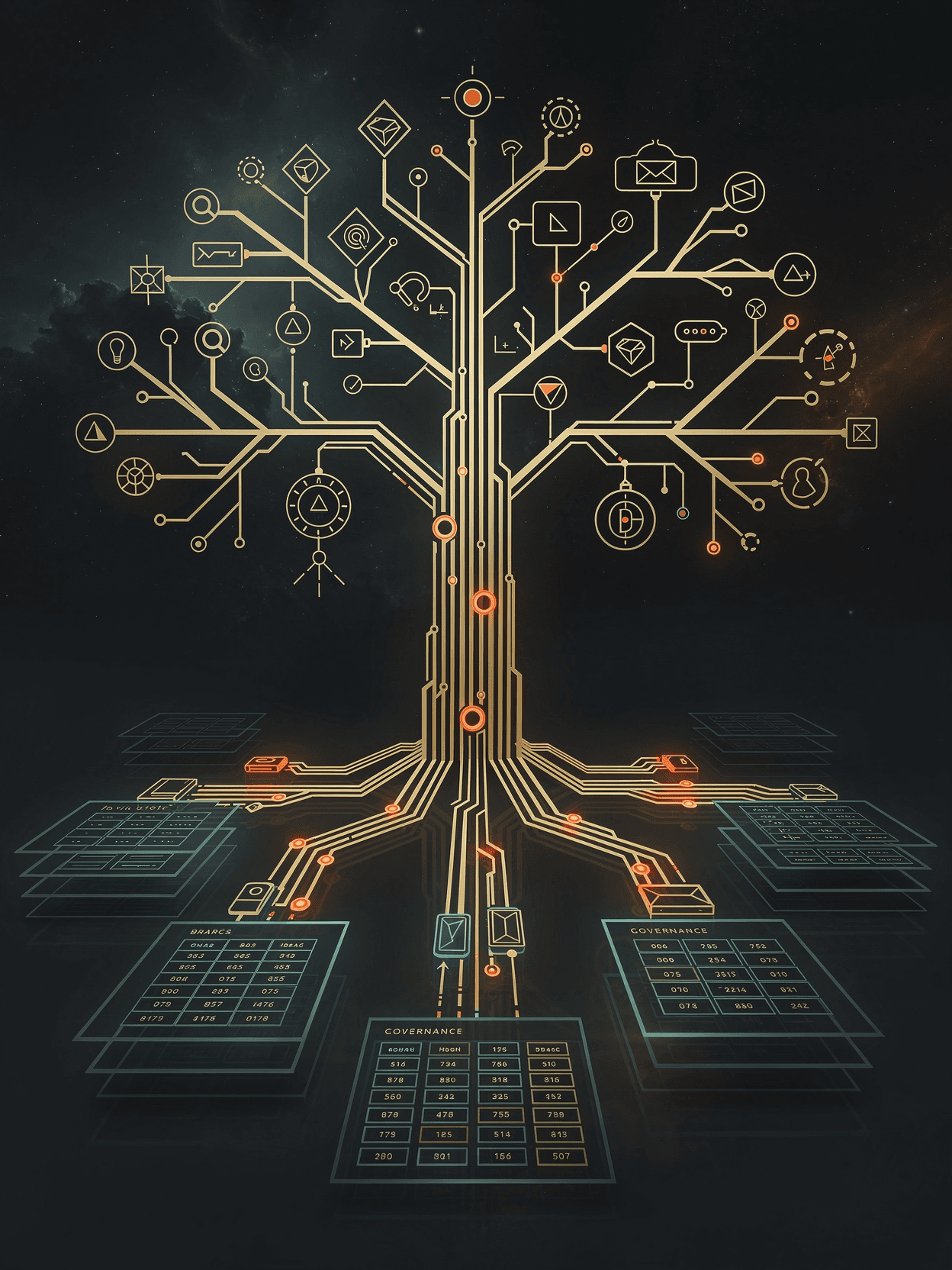
AI-Safe System of Record
AI safety is the database, not a prompt.
Every state change in Yggdrasil ERP passes through the State Constraint Engine. Every policy is a signed, versioned artifact that compiles into runtime enforcement. AI agents call typed tools that can read and propose. They cannot commit, and they cannot bypass.
Three Tiers of Agent Safety
Safety is enforced where the data lives.
Every other ERP vendor with an AI story enforces safety at the prompt, the identity layer, or the orchestration harness. Yggdrasil ERP enforces it three tiers deep, inside the transaction path.
Tier 1
Typed Tools Layer
AI agents call a typed tools API. Tools return scoped data and emit typed proposals. Agents do not call SQL, do not commit state, and never touch the database directly. Every call is audit-logged with the model class, session, and request ID.
Tier 2
State Constraint Engine
Every state change passes through the State Constraint Engine. It is the only path from any state to any other state. A human edit, a webhook, and an AI proposal accepted by a human all evaluate against the same constraint set. There is no second path.
Tier 3
ROPE Policy Artifacts
Constraints are not code. They are signed, versioned policy artifacts compiled from administrative decisions with cited authority, attached evidence, and full lifecycle. When an agent’s proposal is blocked, ROPE supplies the explanation the auditor will accept.
The result. Yggdrasil ERP is the first system of record where the safety guarantee is not a wrapper around the model. It is the transaction path. Agents propose. The database decides.
Governance-Native Operations
Every record flows through a state machine. Every action is traceable. Every integration is governed.
Governed business operations
Ten integrated modules spanning CRM, Sales, Manufacturing, Warehouse, Finance, Purchasing, PLM, Quality, Service, and Projects. Every record flows through a governed state machine.
Customer & Sales
CRM
- Accounts & Contacts
- Opportunities & Leads
- Pipeline management
- Full workflow automation
Sales
- Quotes with line items
- Orders with line items
- Invoices with line items
- Commissions engine
POS Lite
- Tablet-friendly point of sale
- Catalog grid + cart + payment
- Barcode scanner support
- Real-time inventory sync
- Per-method processing fees
Service
- Ticket management
- RMA processing
- Warranty claims
- Maintenance scheduling
Operations
Manufacturing
- Work Orders with operations & materials
- Work Centers
- OEE (Overall Equipment Effectiveness) tracking
- Shop floor operations
Purchasing
- Purchase Orders
- Supplier management
- Receipts & receiving
Warehouse/Logistics
- Inventory tracking
- Locations & bin management
- Transactions & adjustments
- Picking & fulfillment
Engineering
Finance & Projects
Runtime Operational Policy Enforcement
The ERP that does not believe in edge cases.
Every operational situation that today migrates out of the system — into spreadsheets, side conversations, and tribal knowledge — becomes a signed, dated, version-controlled Policy that the runtime enforces directly.
Decisions, Signed and Versioned
Every Policy is an attested administrative artifact — draft, review, signature, activation, amendment, expiration. Nothing operates on the floor without a chain of signatures behind it.
Compiles to Runtime Enforcement
A signed Policy compiles into four artifact kinds — state constraints, roles, approval flows, and workflow templates — that the State Constraint Engine enforces on every transition. No bypass path. No “I’ll fix it in the database.”
Standard Library of Templates
Federal and broad regulatory compliance Policies ship as importable templates — AS9100, ITAR, FDA 21 CFR Part 11, SOX, GDPR controls. Mimisbrunnr carries the vocabulary; you sign the version you accept.
How It Works
From Policy to Enforcement
ROPE is the bridge between human governance and the runtime. Tenant administrators write Policies — with conditions (AND/OR/NOT, IF/THEN, named-condition references) and multiple actions per Policy. Signed Policies compile down to artifacts the State Constraint Engine evaluates on every state transition.
- Compound predicates with AND / OR / NOT and IF / THEN grammar
- Named Conditions library — shared, version-pinned clauses (@v3)
- Policy Phases — pre-gate / gate / post-gate / observer ordering
- JSONB extension capture — prompts users for data at the moment of transition
- No-delete principle — amend, supersede, suspend, expire, obsolete; never delete
Lifecycle
Draft → Signed → Active → Superseded
1. Author the Policy
Tenant admin defines entity, transition, conditions, and one or more actions in the Rule Builder. Saves as draft.
2. Review & Sign
Required signers (legal, quality, compliance, controller) countersign the Policy. Evidence attachments and external references are bound to the signature.
3. Compile & Activate
The Policy compiles into state constraints, roles, approval rules, and workflow templates. The State Constraint Engine enforces them on every transition.
4. Amend or Supersede
Reality changes. The previous Policy stays in the audit trail forever; the new one is countersigned, dated, and takes effect from its activation timestamp forward.
The Yggdrasil Network
B2B Event Broker
Every Yggdrasil tenant is a node on a shared event mesh. When your customers and suppliers run on the same network, orders, invoices, and shipping notices flow automatically — no EDI, no CSV exports, no phone calls.
Supply Chain Streaming
Purchase orders placed with a supplier on the Yggdrasil network arrive as sales orders in their system — instantly. Shipment confirmations, invoices, and receipts flow back the same way.
Cross-Tenant Workflows
Workflows don’t stop at your company’s boundary. A quality non-conformance can trigger a supplier CAPA. A service request can spawn a work order at a partner facility.
Network Effects
Every tenant that joins the Yggdrasil network increases the value for everyone already on it. As saturation grows within your supply chain, the need for human data entry trends toward zero.
How It Works
Event-Driven, Not Batch-Driven
Traditional B2B integration means EDI translators, scheduled file drops, and reconciliation jobs. Yggdrasil replaces all of that with a real-time event mesh powered by RedPanda (Kafka API compatible). Events are published the moment a transaction occurs and consumed by every relevant tenant in milliseconds.
- 10 module-specific event topics (CRM, Sales, Purchasing, etc.)
- Central account and audit topics for coordination
- Secure tenant-to-tenant routing via Cloudflare Tunnel
- Full audit trail on every event for compliance
Example Flow
Purchase Order → Sales Order
1. Buyer Creates PO
Purchasing module publishes an order event with line items, quantities, delivery dates, and pricing.
2. Event Mesh Routes
RedPanda delivers the event to the supplier’s tenant in real time. No polling, no file exchange.
3. Supplier Receives SO
The supplier’s Sales module automatically creates a sales order with all data pre-filled. No re-keying.
4. Fulfillment Flows Back
Shipment confirmations, invoices, and receipts stream back to the buyer automatically as the order progresses.
Client Applications
Qt 6 Desktop Client
Reference Implementation- Native cross-platform application
- Dark & light themes
- 10-module navigation
- Record detail pages with workflow bars
- Save/error notification system
- Server auto-discovery
Next.js Web Portal
In Progress- Modern React-based web UI
- Responsive design
- Real-time updates via WebSocket
- Customer self-service portal
Under the Hood
Multi-Tenant Architecture
Row-level tenant isolation across 323 tables with PostgreSQL.
Path-Based SSO
Single sign-on across the Mimir Labs suite via app.mimirlabs.net. Cookie scoped to .mimirlabs.net carries identity across products.
Real-Time Event Streaming
WebSocket-powered B2B Event Hub for cross-tenant supply chain automation.
Runtime Operational Policy Enforcement (ROPE)
Tenant-scoped governance layer that compiles signed administrative decisions into enforceable runtime constraints, roles, approval flows, and workflows. The ERP that doesn’t believe in edge cases.
Revision Control on BOMs
Full revision tracking with status workflows on EBOMs and MBOMs, plus production exception MBOMs for sanctioned shop-floor deviations.
OEE Tracking & KPI Dashboards
Overall Equipment Effectiveness tracking with real-time KPI dashboards.
Full Audit Logging
Every data change is tracked with timestamps, user IDs, and before/after state.
Tenant Label Overrides
Rename modules and entities (Item Masters → Recipes, Sales Orders → Tickets) without touching code. One-click vocabulary presets for Restaurant, Field Service, and Light Retail.
Governed Extension Fields
Need a field the core schema doesn’t carry? Administrators define it once, at the table level, with a real type, and it appears validated on every record of that table. Extensions live in a governed namespace that never forks the canonical schema. You get the flexibility you actually need without the custom-field drift you don’t.
Payment Processing Fees
Per-method, per-processor fee schedule with pass-through and merchant-absorbed support. Live fee preview on every payment surface.
PostgreSQL Database
323 tables across 17 business domains, indexed for performance and integrity.
Agent Execution Layer
Webhook + audit + proposal infrastructure for AI assistants. Agent suggestions land as typed proposals; humans accept, reject, or edit before any state change.
All-Inclusive Platform
All 10 modules included in every subscription. One integrated system, not piecemeal add-ons.
Framework Alignment
A reference implementation of the CAIP-HE framework.
CAIP-HE is a platform-agnostic reference framework for intelligent ERP authored by Tirumala Rao Chimpiri. It defines the four capability conditions that have to operate together for an ERP to evolve from a system of record into a decision-enabling system: Cognitive Automation, Advanced Analytics, Integration & Interoperability, and Personalization. It is conceptual, not a product — a lens for assessing ERP modernization, not a thing you install.
Yggdrasil ERP is built such that all four pillars are first-class architectural commitments, not bolt-ons. Where the framework describes the conditions, Yggdrasil demonstrates the build.
Cognitive Automation
Decisions and actions carried out consistently
The State Constraint Engine and Runtime Operational Policy Enforcement layer convert signed administrative decisions into runtime enforcement on every transition. The Agent Execution Layer lets AI assistants propose state changes that humans accept, reject, or edit — orchestration that stays attributable.
Advanced Analytics
Predictive and prescriptive, not retrospective
Real-time OEE tracking, MRP demand projection, KPI dashboards, and an append-only audit change log over a deterministic data model. The same canonical schema serves operational reporting and predictive workloads — no warehouse-of-warehouses reconciliation tax.
Integration & Interoperability
Intelligence travels across system boundaries
The B2B Event Broker streams transitions tenant-to-tenant in real time. Bifrost connects external ERP/CRM/HCM systems with Mimisbrunnr as the semantic Rosetta Stone, so meaning is preserved across every boundary — not just the bytes.
Personalization
Role-aware, context-sensitive delivery
Tenant Label Overrides, RBAC role tooling inside ROPE, JSONB extensions captured at transition time, and per-tenant vocabulary presets (Restaurant, Field Service, Light Retail). Each user sees the data and authority surface aligned to their decision rights — not a generic console.
CAIP-HE Reference Framework © Tirumala Rao Chimpiri. Used here as a structural lens. Mimir Labs is not affiliated with the framework’s author; the framework is platform-agnostic and vendor-independent.
Pricing
Licensed by governed operating footprint.
Not by seat. Not by module.
Yggdrasil's annual license is computed from a published formula:$75,000 + ($15,000 × Footprint Score)
Every dollar of price maps to a verifiable customer input. The Pricing page lays out the formula, walks through worked examples, and exposes an interactive calculator that decomposes your score in real time.
Organizations who complete a Ratatosk workshop or a Ragnarok migration receive a 1:1 credit of those fees against Yggdrasil activation.
Start a Conversation
Tell us about your operation and we'll discuss whether Yggdrasil is the right fit.